Oil-Bathed Timing Belt: What to Check Before Buying
The key is not to judge all these engines alike, but to establish which configuration the car has and whether its history confirms the specified oil and the maintenance prescribed by the manufacturer.
Key points
An oil-bathed timing belt alone tells you neither how reliable a used car is nor what it will cost to maintain. Identify the exact engine, then compare its manual, the oil used and the invoices with the official maintenance schedule.
Wet belt, dry belt or chain: what changes—and what you cannot conclude
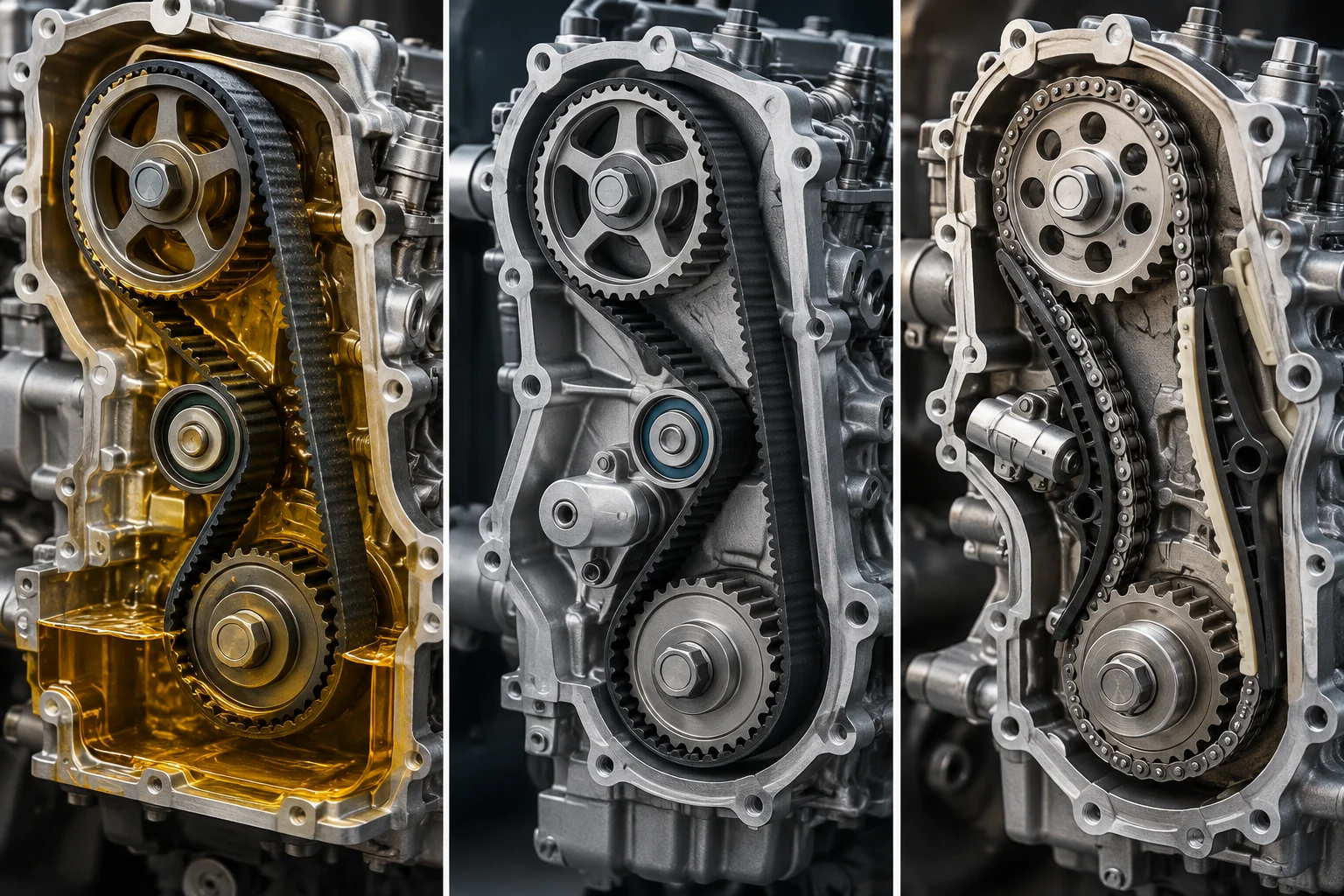
An oil-bathed timing belt, also called a wet belt, operates inside the engine and is in contact with the oil. A dry belt, by contrast, sits outside the oil bath. A timing chain is a different type of drive component: it should not be confused with a belt, even though both perform a synchronisation function. The sources consulted describe the wet belt as a design intended to reduce friction and fuel consumption, but that technical aim does not, by itself, establish the reliability of a particular engine.
For someone buying a used car, the practical difference is that the oil and documented maintenance become important checks. RACE and Autocheck recommend reviewing invoices and verifying the oil used; Motor16 warns that using oil that does not meet the exact approval specified in the manual can damage the engine and belt. It is not enough for the seller to say the oil was good quality: its specification needs to be checked against the requirement for that particular car.
Nor is it right to assume that all wet belts have the same service interval, cost or risk. The available sources do not provide a universal official schedule or identify specific engines and versions with their respective instructions. The useful comparison is between the maintenance required for the exact engine and what its history actually proves—not between general labels.
| System | Relationship with oil | What to check before buying |
|---|---|---|
| Oil-bathed belt | Operates in contact with engine oil | Applicable manual, oil approval and invoices |
| Dry belt | Does not operate immersed in engine oil | Exact system and maintenance prescribed for the car |
| Chain | Not a belt | Confirm that the engine has a chain and check its official schedule |
Section references: RACE - Correa de distribución húmeda: qué es y mantenimiento ↗ · Motor16 - Correa de distribución húmeda en aceite ↗ · Wynn's España - Correas de distribución bañadas en aceite ↗
- Wet belt: operates in contact with the engine oil.
- Dry belt: sits outside the oil bath; it is still a belt, not a chain.
- The stated aim of reducing friction or consumption does not replace maintenance checks.
- The exact oil specification must come from the manual for the relevant engine, year and market.
Identify the car’s engine, not just its model name
The model name alone is not enough to establish which timing system a car has. A single model name can cover different versions; to find out, match the specific vehicle to its engine, year and market, then consult the manufacturer documentation for that combination. The available sources do not provide a complete, verifiable list of models and years, so it would be unwise to attribute wet belts to an entire brand or engine family.
Start by gathering the vehicle identification details in its documents and ask the seller for the car’s specification sheet, the engine code or identification where available, and the relevant manual. If the manual supplied is generic, find the maintenance section for that engine or ask the manufacturer or its dealer network for confirmation. The answer needs to refer to that version, not simply say, “This model usually has one.”
If you cannot confirm the system, treat the question as unresolved—not as proof of a defect or a guarantee that no issue exists. Before completing the purchase, write down what remains unclear: whether it has a wet belt, what its maintenance schedule is, or which oil it requires. Uncertainty about the identification also prevents a sound estimate of future work or a meaningful cost comparison.
Section references: Autocheck Cantabria - Correa bañada en aceite: qué motores la llevan y riesgos ↗ · RACE - Correa de distribución húmeda: qué es y mantenimiento ↗
- Record the advertised car’s model, year, version and market.
- Ask for the engine details and compare them with the applicable manual or official schedule.
- Be wary of answers based only on the brand, engine capacity or model name.
- If the seller cannot clarify, request manufacturer confirmation or a professional check before deciding.

Compare the official schedule with invoices and service history
Once you have identified the engine, find the required oil, service schedule and any planned timing-system checks or work in the manual or official documentation. Do not extrapolate intervals from another engine or treat a general recommendation found online as an official interval. If the document does not make clear which variant it covers, ask the manufacturer or an authorised service centre to clarify.
Next, piece together the history using invoices, work orders and maintenance records. Check the dates and mileages of each oil change and look for the stated specification or approval; an invoice that says only “oil” does not establish whether it matched the manual. RACE and Autocheck specifically recommend requesting invoices and checking the type of oil used. If information is missing, record that gap as a purchase uncertainty rather than assuming the work was done correctly.
A visual inspection can provide an additional check when the applicable maintenance procedure calls for one. FEBI says that in engines such as the PureTech, the belt should be visually checked at every service; this does not mean that the same instruction applies automatically to every engine, nor does it establish a replacement interval on its own. Ask the workshop to explain what it inspected, according to what criteria and what result it recorded.
| Check | Useful evidence | What to do if it is missing |
|---|---|---|
| Oil used | Invoice stating the specification or approval | Ask the workshop that performed the change for details |
| Maintenance continuity | Invoices and records with dates and mileages | Treat the history as incomplete and request an inspection |
| Belt condition | Inspection note made in line with the applicable schedule | Request an independent professional check |
| Future work | Official schedule for that engine | Ask for the relevant document or specific confirmation |
Section references: Autocheck Cantabria - Correa bañada en aceite: qué motores la llevan y riesgos ↗ · RACE - Correa de distribución húmeda: qué es y mantenimiento ↗ · FEBI Bilstein Blog - Correas bañadas en aceite (MOTOR PURETECH) ↗
- Applicable manual: confirm the oil, service schedule and planned work for that engine.
- Invoices: cross-check the date, mileage, work carried out and oil specification.
- Incomplete records: do not fill in the gaps with assumptions; request further evidence.
- Visual inspection: use it only as required by the applicable schedule, and keep a record of what was checked.
Questions for the seller and an independent inspection
Ask specific questions and request supporting documents. “Has it been well maintained?” is too general; you need to know what oil was used, when and at what mileage, what timing-system work was done, and whether an inspection was recorded. Check each answer against invoices, not just a stamped service book or a verbal explanation.
Before paying a non-refundable deposit, arrange an independent inspection if there are gaps, doubts about the oil specification or discrepancies between the advert and the documents. Give the workshop the engine identification and official schedule, and ask it to report separately on what it can and cannot confirm. Do not ask for a general verdict on “all wet belts”: the aim is to assess this particular car and its history.
A missing invoice does not, on its own, prove that a fault has occurred; it does make the maintenance harder to verify. If the seller refuses to show documents, will not allow a reasonable inspection or will not resolve an important discrepancy, it is sensible to postpone the decision or look at another car. If you remain interested, account for the uncertainty in your costs and negotiations without inventing a repair that may not be required.
Section references: Autocheck Cantabria - Correa bañada en aceite: qué motores la llevan y riesgos ↗ · RACE - Correa de distribución húmeda: qué es y mantenimiento ↗
- Which exact engine does it have, and what document confirms its timing system?
- What oil approval was used, and where is it stated on the invoices?
- What belt checks or maintenance have been carried out, and when?
- Can an independent workshop inspect it before the deal is completed?
- What specific information is missing, and who can confirm it?
Assess expected costs without treating the label as a verdict
The sources reviewed provide no universal figure for maintenance, replacement or repair that applies to every engine with a wet belt. Nor do they provide official intervals that can be compared across versions. To estimate the cost for a specific car, first establish whether the manufacturer requires any work during the period you plan to own it; then request a written quote from a workshop familiar with that engine and check what it includes and under what conditions.
Separate expected expenditure from uncertainty. Work listed in the official schedule and due soon by time or mileage can be priced; missing invoices or an unverified oil specification call for an inspection or further documents, not an invented figure. Compare the purchase price plus confirmed upcoming maintenance with other cars whose engines and histories are also identified. That way, you do not penalise or reward a technology without considering the actual evidence.
The decision can be summed up in three scenarios: a consistent history and specific documentation, which provide a firmer basis for assessing the car; an incomplete history but a seller willing to allow checks, which makes it sensible to budget for an inspection before closing the deal; and significant unanswered questions, with neither documents nor access to an inspection, where postponing or abandoning the purchase may be more prudent. None of these scenarios is, by itself, a diagnosis of a fault: they are ways to decide in light of the available uncertainty.
| Scenario | Prudent interpretation | Next step |
|---|---|---|
| Engine identified and consistent history | The available information supports an assessment of documented maintenance | Check the future schedule and applicable quote |
| Partial history, with access to an inspection | Questions remain that can be checked before buying | Request an independent inspection and complete the records |
| Engine identity or maintenance unclear | Risk and cost cannot be assessed with confidence | Postpone the decision or consider another car |
Section references: RACE - Correa de distribución húmeda: qué es y mantenimiento ↗ · Motor16 - Correa de distribución húmeda en aceite ↗
- Ask for a quote based on the identified engine and official schedule, not a generic estimate.
- Distinguish work that is due under the schedule from a suspicion that still needs diagnosis.
- Compare total cost and history across equivalent cars, not just advertised prices.
- If essential details are missing and cannot be checked, do not assume the system’s condition is confirmed.
Does an oil-bathed timing belt mean the engine is unreliable?
You cannot conclude that from the design alone. Identify the engine and check its prescribed and documented maintenance; the sources consulted do not support a universal verdict.
How can I check which oil was used?
Ask for invoices or work orders stating the oil specification, then compare it with the exact approval in the manual for that engine.
Can I tell whether it has one just from the model name?
Not reliably based on the information available. Confirm the engine, year and market, then consult the manufacturer documentation for that specific car.
What should I do if maintenance invoices are missing?
Treat the history as incomplete, ask the seller or the workshop that carried out the work for records, and request an independent professional check before deciding.