Air or liquid cooling in motorcycles: which suits your use
Discover the differences between air and liquid cooling in motorcycles. We analyze costs, maintenance, and performance to help you choose the right system for your riding profile.
Key points
Air cooling is cheaper, simpler, and lighter, making it ideal for urban bikes and low-maintenance needs. Liquid cooling offers superior thermal stability for high-performance engines but requires a more complex and costly maintenance system.
Fundamental differences between both systems
Choosing between air and liquid cooling in a motorcycle is not just an aesthetic issue, but a matter of engineering and maintenance. Both systems aim to cool the engine to prevent wear and ensure optimal operation over time.
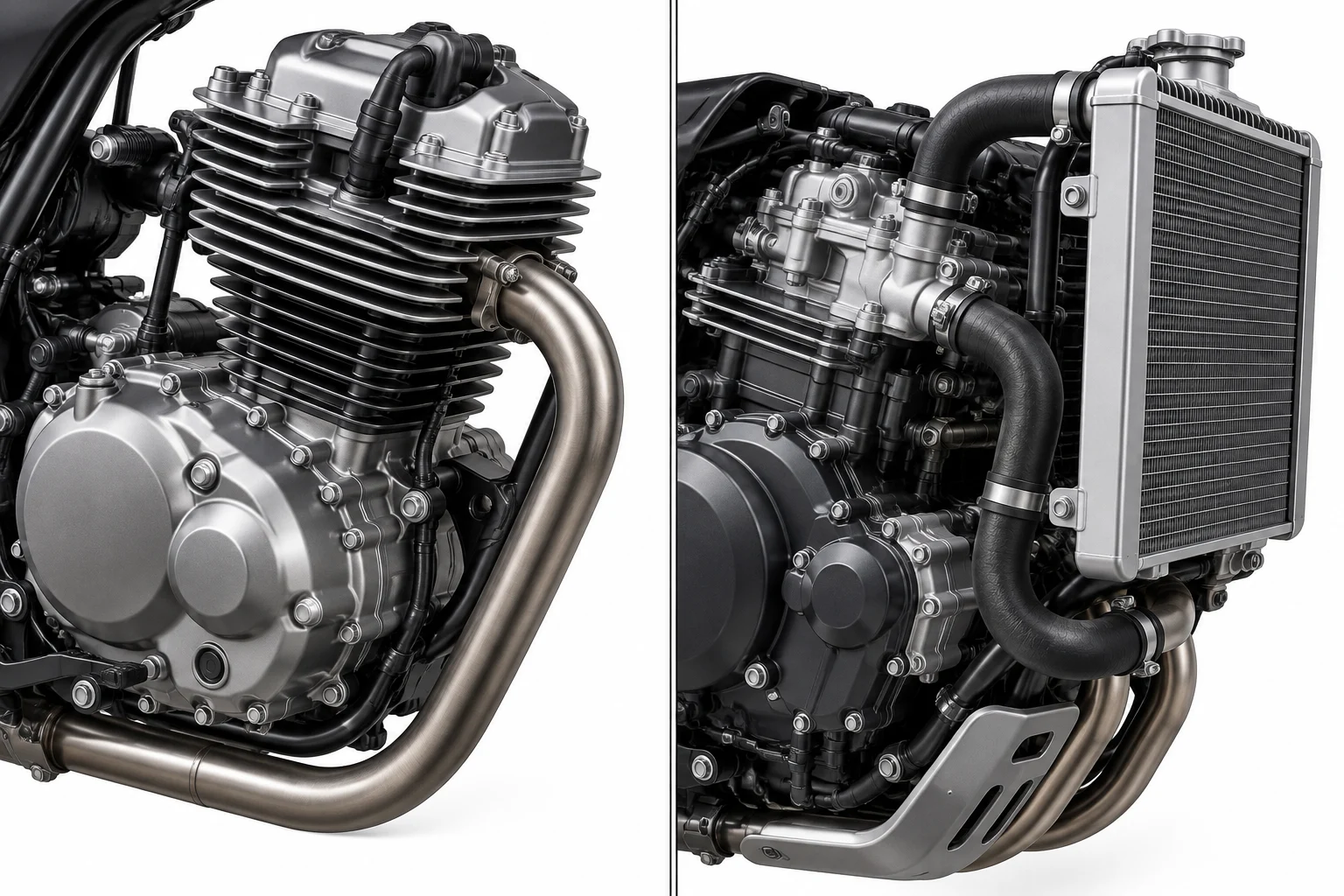
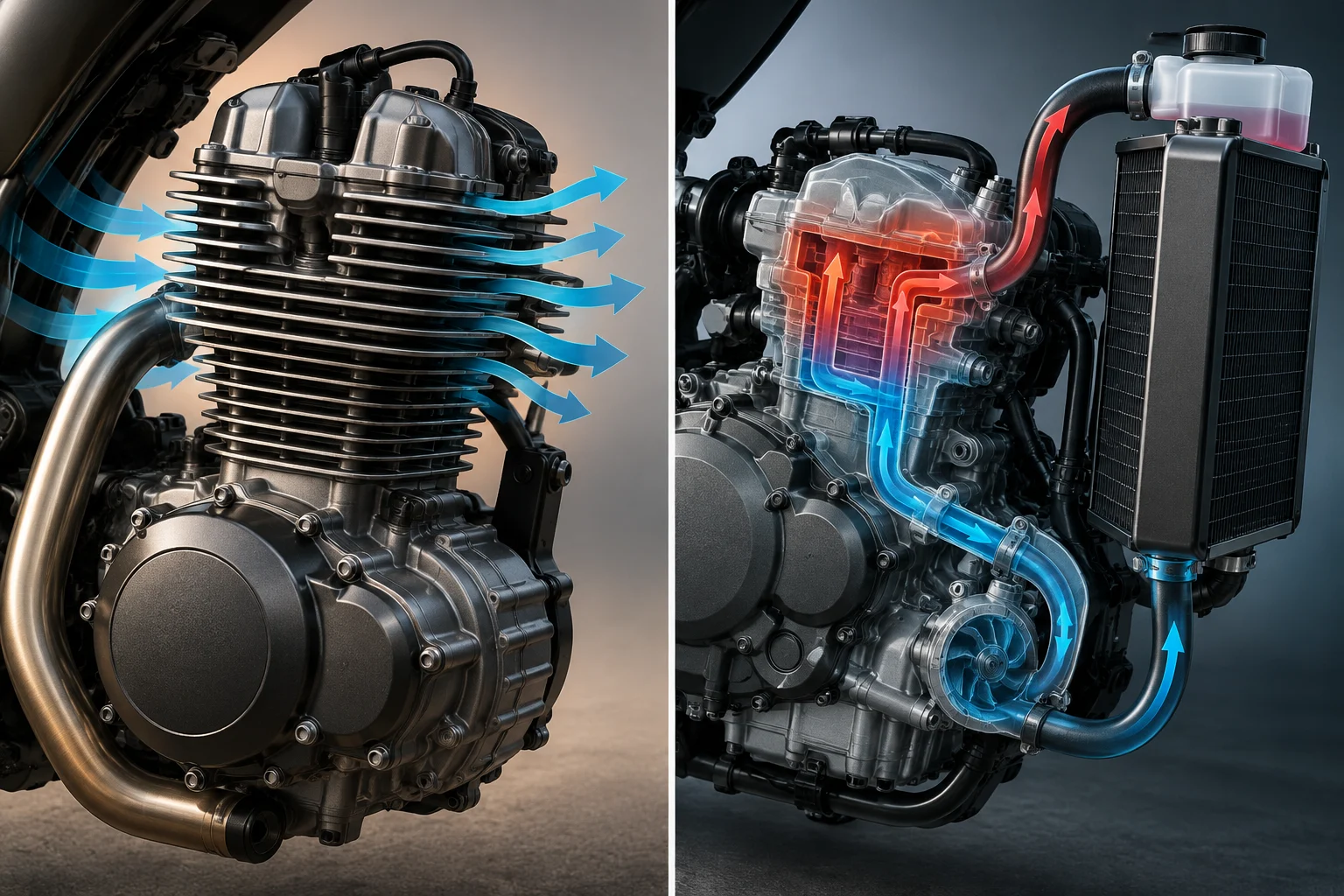
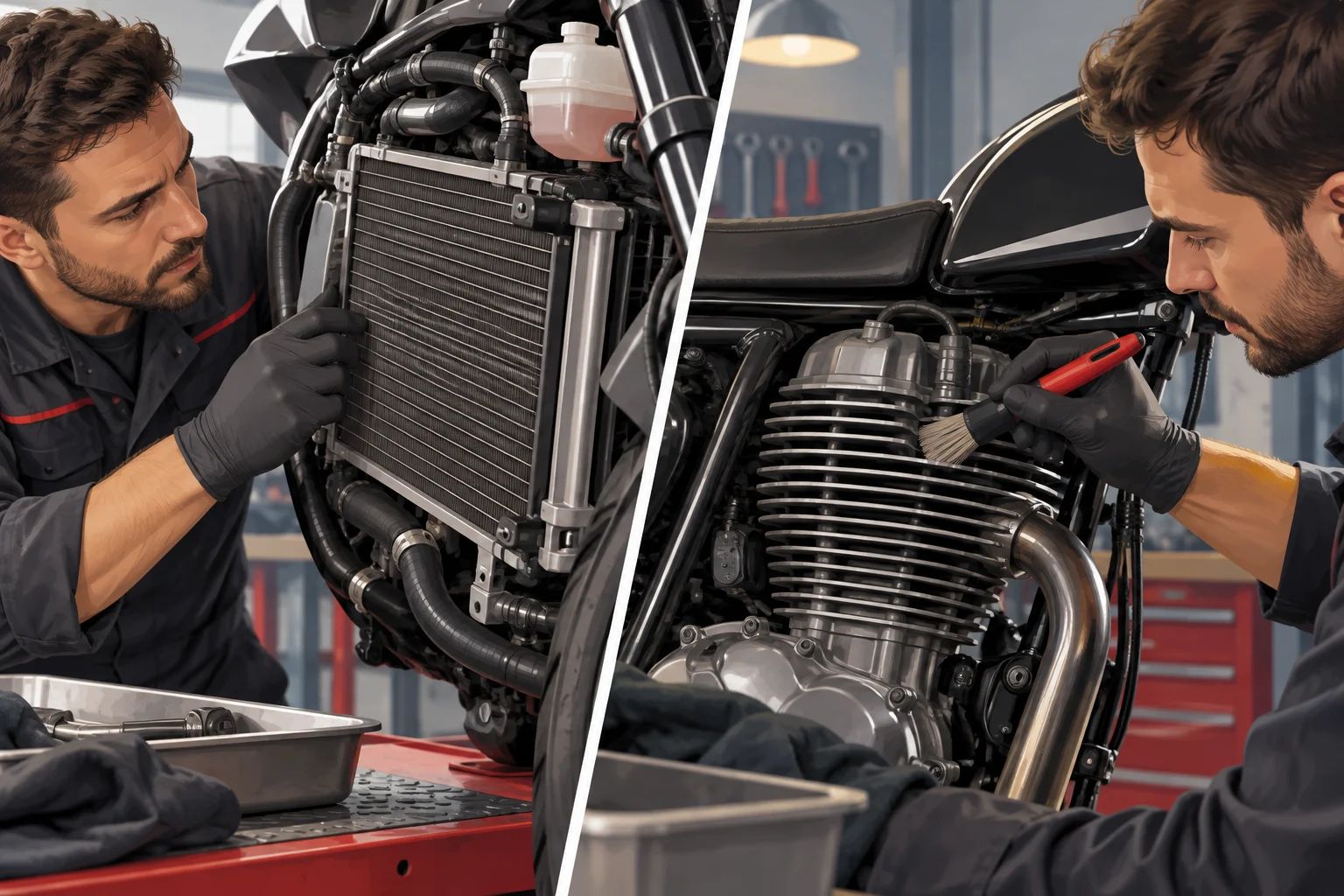
Air cooling is an older and more direct mechanism. It uses metal fins on the engine block and, in many cases, a fan to dissipate heat to the outside. This system is known for being cheaper, taking up less space, and being easier to understand and repair.
In contrast, liquid cooling employs a closed circuit with coolant circulating through the engine and passing through a radiator. This method allows for more precise thermal control, which is crucial in high-power engines or extreme use conditions, although it implies superior mechanical complexity.
Section references: Qué es mejor para la moto: Refrigeración líquida o por aire ↗ · Diferencias entre refrigeración por aceite y por aire ↗
- Air cooling: cheaper, simpler, and lighter.
- Liquid cooling: greater thermal stability and sustained performance.
- Both systems aim to prevent premature engine wear.
- The air system is noisier in some models due to the fan.
Maintenance and long-term costs
One of the decisive factors for many owners is maintenance cost. Air-cooled engines are generally simpler, lighter, and easier to maintain. Without a liquid circuit, they do not require coolant changes or inspections of hoses and radiators.
In contrast, liquid cooling involves a more complex, higher-maintenance, and more expensive system. It is necessary to periodically check the liquid level, the condition of the hoses, and the efficiency of the radiator. A leak in this system can be more difficult to detect and repair than a problem in an air-cooled engine.
For urban use and low mileage, the simplicity of the air system is usually a clear economic advantage. However, for those who make long trips or use the bike in heavy traffic, the thermal efficiency of the liquid system may justify the higher maintenance cost.
| Aspect | Air cooling | Liquid cooling |
|---|---|---|
| Complexity | Low | High |
| Initial cost | Lower | Higher |
| Maintenance | Simple | Requires circuit inspection |
| Weight | Lighter | Heavier |
Section references: MANTENIMIENTO BASICO DE MOTOS ↗ · ¿cuál es mejor para los conductores de 125 cc, 250 cc y 300 cc? ↗
- Air engines: no coolant changes required.
- Water engines: periodic inspection of hoses and radiator.
- The air system is lighter, which can improve agility in the city.
- The water system requires more parts, increasing potential repair costs.
Performance and thermal stability
A motorcycle's performance largely depends on its ability to maintain a stable operating temperature. Air cooling is effective under normal conditions but can be limited in situations of high thermal stress, such as dense urban traffic or prolonged climbs.
Liquid cooling, by using a fluid with higher heat capacity, allows for more constant temperatures even under high loads. This translates into greater engine durability and more consistent performance over time.
For high-displacement or competition motorcycles, liquid cooling is almost always the preferred option. In contrast, for low-displacement urban bikes, air cooling is usually sufficient and more suitable due to its simplicity and lightness.
Section references: Tipos de refrigeración para motos: ventajas y desventajas ↗
- Liquid cooling: better for high performance and intensive use.
- Air cooling: suitable for urban use and low power.
- Thermal stability improves engine lifespan.
- The air system can be noisier due to the fan.
Which system to choose based on your usage profile?
The final decision depends on how you will use your motorcycle. If your priority is simplicity, low maintenance cost, and lightness for urban use, air cooling is an excellent option. It is ideal for low-displacement bikes and those seeking a complication-free riding experience.
If, on the contrary, you plan to make long trips, use the bike in heavy traffic, or seek sustained performance at high revolutions, liquid cooling offers significant advantages. Its greater complexity is compensated by better thermal management and greater engine durability.
In summary, there is no 'better' system in absolute terms, but rather the most suitable one for each need. Evaluate your riding profile, budget, and maintenance expectations before making the decision.
Section references: Qué es mejor para la moto: Refrigeración líquida o por aire ↗ · ¿cuál es mejor para los conductores de 125 cc, 250 cc y 300 cc? ↗
- Urban use and low displacement: air cooling.
- Long trips and high power: liquid cooling.
- Tight budget: air cooling.
- Maximum performance and durability: liquid cooling.
Is air or liquid cooling better?
It depends on the use. Air cooling is cheaper and simpler, ideal for urban bikes. Liquid cooling offers better thermal stability for high performance, although it is more complex and costly to maintain.
What maintenance does liquid cooling require?
It requires periodically checking the coolant level, the condition of the hoses, and the efficiency of the radiator. It is a more complex system than air cooling, which does not need these components.
Is air cooling noisier?
In some models, yes, due to the use of a fan to improve heat dissipation. However, the noise difference is usually minimal in normal use.
Can I change my motorcycle's cooling system?
It is not a standard or recommended modification. The cooling system is specifically designed for each engine, and changing it can affect the vehicle's performance, safety, and warranty.